
Checking Pulaski County Warrants
Pulaski County publishes no name-only list of active warrants. The best public starting point is Indiana MyCase, which can display warrant details inside an eligible public criminal case summary. Remember what it is. MyCase is a case search, not a full warrant database. When you have a case, citation, or cross-reference number, search on that first. A party search works when no number is known, but narrow it to Pulaski County and the likely court. Use the result only for your own matter or one you are authorized to handle, then take the full verification route.
- Gather the legal name, case or citation number, likely court, and approximate filing year.
- Search MyCase and narrow results to Pulaski Circuit Court or Pulaski Superior Court.
- Read the chronological events for issue, service, recall, quash, or failure-to-appear entries.
- Call the Clerk or issuing court to ask whether the docket entry reflects current warrant status.
- Ask the Sheriff about service or safe surrender, or use an APRA request for a specific public record.
Why call the court directly? A public summary in Pulaski County can be stale, incomplete, sealed, or missing later filings.
Pulaski Warrants Start With Cases
Indiana's judicial branch draws a firm line between case access and warrant lookup. MyCase can show warrant information inside a criminal case summary, unless a court has sealed it. What it cannot do is search warrants as a statewide set. A broad name query may miss a file entirely, pull up unrelated people, or display an old event that proves nothing about whether an outstanding warrant still stands. Treat any hit as a lead. For a Pulaski County warrant check, open the official MyCase interface, the public case-search entry point, and work from the case itself.
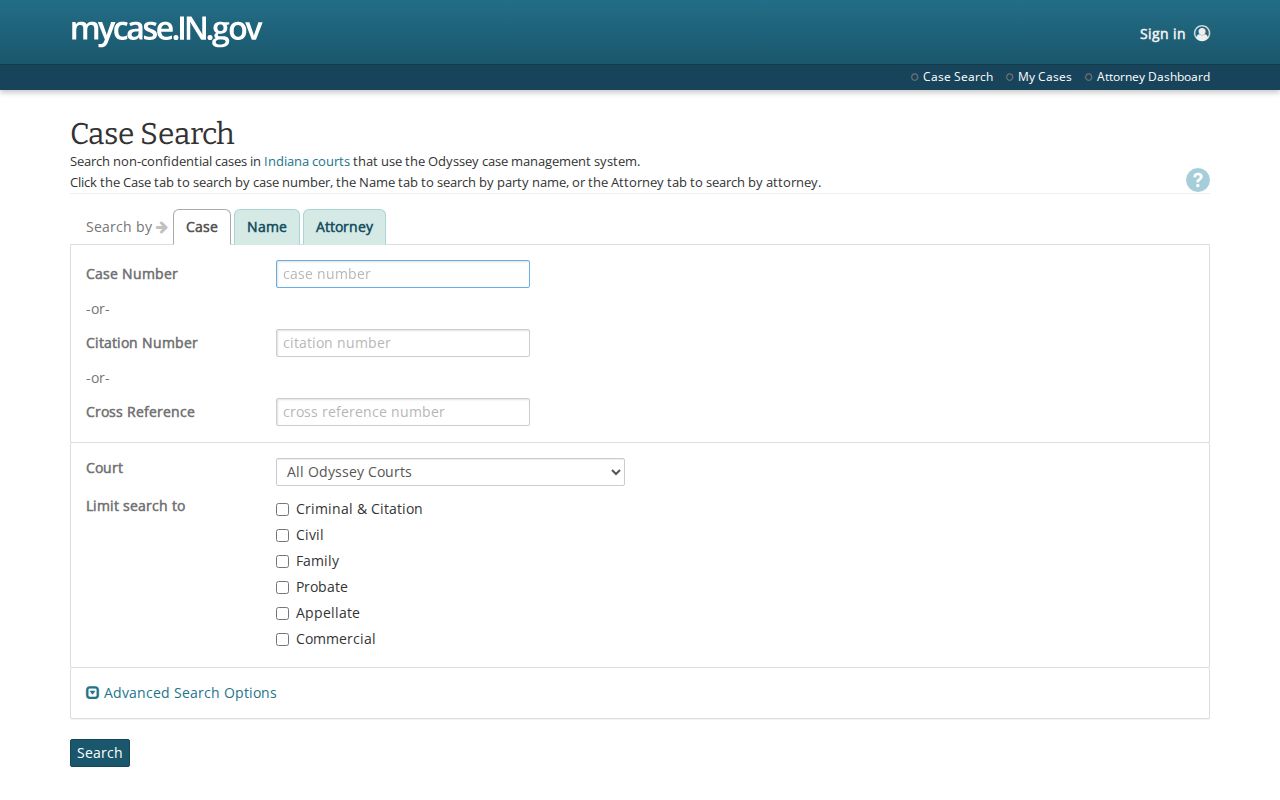
The interface supports several search modes. Case, citation, cross-reference, party, and attorney queries all work. There is no export button and no control for pulling a complete Pulaski County warrant list. Open a likely case and read its full public event history.
Pulaski County Warrant Types
What controls a Pulaski County warrant is the docket and the signed order, not the label. Still, the common labels help a reader see why an entry appeared. A bench warrant is a court order for arrest in a civil or criminal case. It usually follows a missed duty. Recall or quash is later court action that changes the warrant's effect.
| Warrant Type | How It Arises | Who Issues It |
|---|---|---|
| Arrest warrant | Charging and probable cause support arrest | Circuit or Superior Court |
| Bench warrant | A court directs arrest in a pending matter | The judge handling the case |
| Failure-to-appear warrant | A required appearance is missed after notice | The court with the case |
| Search warrant | Probable cause supports a particular search | A judge under Indiana law |
Pulaski County dockets use terms like "bench warrant," "warrant," and "failure to appear." The phrase "capias pro fine" is not a local term here. Tax warrants and land-use inspection warrants are separate records, not criminal arrest warrants.
Pulaski County MyCase Fields
MyCase works best with a record identifier in hand. Indiana guidance says case numbers need no hyphens and no leading zeroes. With only a name, cut false matches by filtering on county, court, status, case type, and dates for Pulaski County. Broad queries can hit the portal's one-thousand-result cap.
| Mode | Useful Input | Pulaski Use |
|---|---|---|
| Case | Case, citation, or cross-reference number | Best for one known file |
| Party | Last name; first, middle, and birth date can narrow | Apply county and court filters |
| Court filters | County, court, case type, status, dates | Select Circuit or Superior |
| Attorney | Attorney number or name | Use when counsel is known |
Bulk extraction is not allowed, and repeated rapid searches may prompt a CAPTCHA. Current Pulaski County codes are 66C01 for Circuit and 66D01 for Superior. Code 66E01 marks an abolished county court, not a current venue.
Inside a Pulaski County Warrant Record
An Indiana arrest warrant can state the person's name or description, the offense, the date and county of issue, a signature, the command to arrest, and bail information if ordered. A MyCase summary may show less. It can list a docket event while the signed warrant or affidavit never appears online. For the full Pulaski County record, go to the source.
| Cause number | The case identifier and Pulaski court code |
|---|---|
| Event | Issue, failure to appear, service, recall, quash, hearing, or later order |
| Issuing court | Circuit or Superior Court and county |
| Charge | The public offense description |
| Release terms | Bond or conditions if publicly shown |
| Status | The latest public event, still subject to confirmation |
Not every field is public in Pulaski County. Protected personal data, victim information, confidential cases, and excluded documents may be redacted or withheld, and the Clerk supplies the official record.
Pulaski County Has No Warrant List
The Sheriff's current page gives office contacts and service links, but no active-warrant search, downloadable list, most-wanted roster, filter, or update schedule. A jail roster shows who is in custody now, not every unserved warrant. The sex-offender link serves another legal purpose. Neither can answer a warrant-status question for Pulaski County. The official Sheriff's Office page is the source for published law-enforcement contacts.
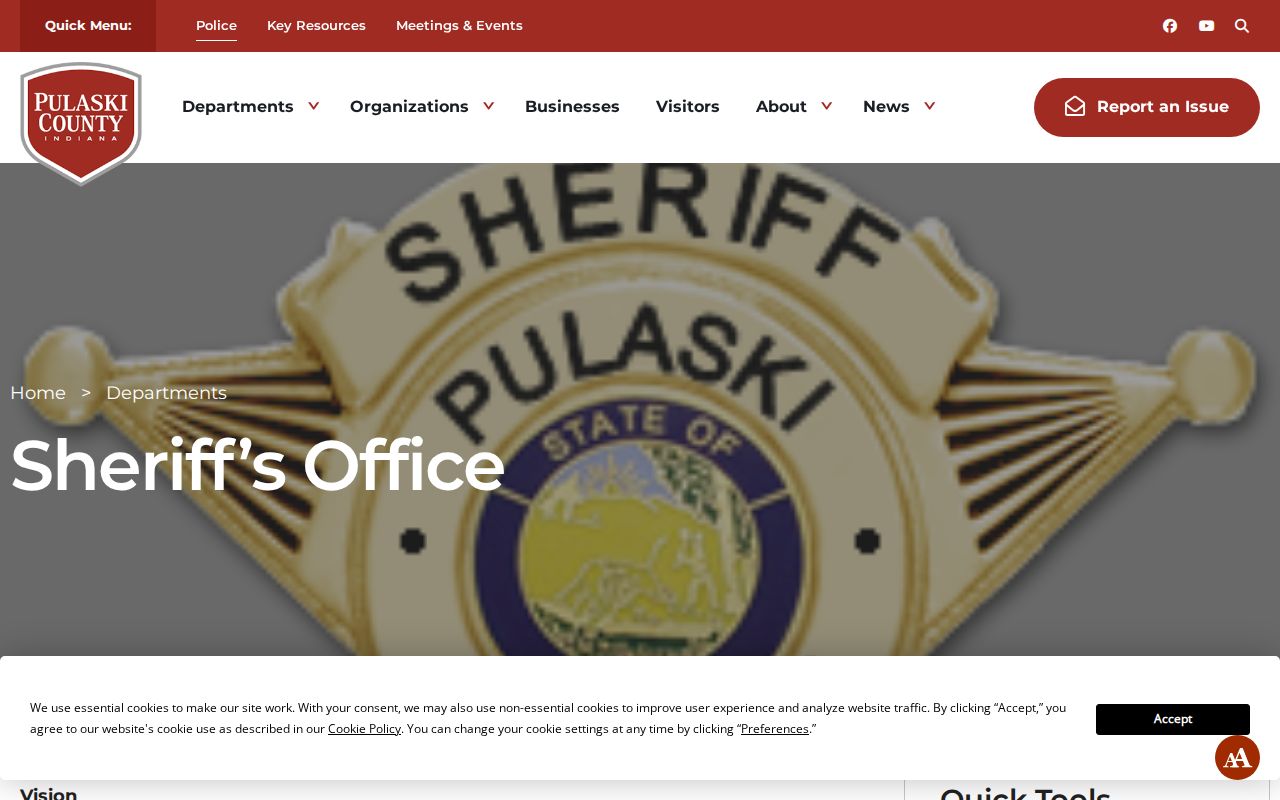
That page supports direct inquiry, not a public database. A missing web result is never proof that no Pulaski County warrant exists. Indiana also runs no public site that searches all arrest warrants statewide.
Issuing and Serving Pulaski Warrants
Pulaski County has two current trial courts: Pulaski Circuit Court and Pulaski Superior Court. A judge issues a judicial warrant. The Sheriff or another officer executes it. The Prosecutor may file the case, but that office is not the public warrant-status counter. Probation may report a violation, yet only the court can alter its own order.
Clerk of Courts
Public files, orders, fines, copies, and docket questions. Courthouse room 018; call first because official sources differ on the street-address presentation.
574-946-3313
Pulaski County Sheriff
Service, custody, execution, and safe surrender questions. Justice Center first floor, 110 East Meridian Street, Winamac.
574-946-6655
Pulaski County Courts
Circuit: 574-946-3851. Superior: 574-946-3371. Ask the court on the case about orders and hearings.
Court issues warrant → Clerk maintains case record → officer serves warrant → court records service, recall, quash, release, or the next hearing.
Two Pulaski County Records Stops
County records work is split across offices in Winamac. The courthouse footer lists 112 East Main Street. The Circuit and Superior court pages place the courts and the Sheriff in the Justice Center at 110 East Meridian Street. The Clerk page puts its public office in courthouse room 018, while the current state directory lists 117 East Main Street for the Clerk. Call before you travel. Staff can confirm the right entrance. The Pulaski County office directory brings the Clerk, courts, Sheriff, Prosecutor, and Probation contacts together in one place.
This split is why one call rarely settles everything in Pulaski County. Status, service, payment, and supervision can each belong to a different office.
If You Have a Pulaski Warrant
Confirm first, then act. Before you pay, travel, appear, or surrender, ask the issuing court in Pulaski County whether the warrant is still active, whether you must file a motion or show up, and what bond or release terms apply. A lawyer on the case can lay out the options and contact the court for you. No single public Pulaski bond schedule governs every case, so the court's answer is the one that counts.
Act safely: Do not approach a law-enforcement counter without asking how the Sheriff wants a person with a possible active warrant to proceed. Do not evade service. Use official numbers and get instructions from the court or Clerk.
Eligible traffic cases in Pulaski County can go through Indiana traffic ePay. Paying is not the same as recall, though, so confirm the warrant was lifted. A probation issue calls for two calls: the supervising court and Pulaski Probation. Pulaski County runs no amnesty event, posts no online recall form, and sets no fixed warrant-clearing fee.
Pulaski County Warrant Terms
A short docket label can hide a lot. Read it against the full case history, then ask the Pulaski County Clerk or the court what the newest order actually means.
- Bench warrant
- A court-issued arrest warrant in a civil or criminal case.
- Failure to appear
- A missed required appearance with consequences set by law and court order.
- Recall or quash
- Court action changing the warrant’s effect.
- Probable cause
- The legal basis for the relevant warrant or charge.
- Bond or bail
- Release terms or security set by the court.
- APRA
- The Indiana Access to Public Records Act.
"Issued," "served," and "recalled" sit at different points in time. The newest official entry matters most. Still, a call to the Pulaski County office is the safest final check.
Pulaski County Warrants and Public Access
Indiana Access Rule 4 sets the general framework for court-record access, and Access Rule 5 covers exclusions, protected data, and redaction. Warrant material can be public. But a judge may exclude or seal it when recognized risks justify that step. Juvenile, expunged, confidential, victim, and protected identifying information may not appear at all in Pulaski County records.
Key access rules:
Indiana Code 5-14-3 is APRA and governs agency requests subject to exceptions.
Access Rules 4 and 5 govern court records and redaction.
An online omission does not prove a record is absent.
A partial record may be available when the full document is not.
MyCase is not the official court record. For certified copies of a public Pulaski County file, the Pulaski County Clerk is the office to call, and the clerk can walk you through the copy process.
Requesting Pulaski Warrant Records
Pulaski County's access form asks for the date, your contact details, the department, a reasonably particular description, and a signature. It warns that copying fees may apply. It names no warrant custodian, filing method, fee schedule, ID rule, or production deadline, so confirm those points with the agency holding the record. Narrow your request to one case, policy, date range, or record type, never every warrant. A good description names the Pulaski office, a tight date span, and the exact record you want. A request for the Sheriff's current warrant-publication policy is not the same as one for an identified public court filing; the first goes to the law-enforcement custodian, the second usually to the Clerk. If the whole record cannot be released, ask whether an electronic or redacted copy exists. APRA requests made in person or by phone generally must be acknowledged within 24 hours, while mail, email, or fax requests generally get acknowledgment within seven calendar days. Acknowledgment is not production. If access is denied, ask which exception was cited and the name or title of the official responsible. Keep the request, the reply, the dates, and any cited rule. The Public Access Counselor can advise and issue opinions but cannot force Pulaski County to hand over a record.
A current-status question and a records request serve different needs. For an active order in one known case, start with the cause number, MyCase, and the Pulaski County Clerk. The issuing court can say whether its docket shows a hearing, recall, service, or another order. The Sheriff can explain its role in the process, but the Sheriff cannot change a judicial order. APRA fits better when you want a policy, a historical record, a retention schedule, or another defined agency document that the live case route will not answer. Choose the office before sharing personal details. The Clerk keeps Circuit and Superior Court records, and both courts control their own orders. The Sheriff handles service and custody logistics, while Probation takes supervision questions but cannot recall a warrant. Traffic cases may use the state payment portal, though a payment screen does not prove a warrant was lifted. For a relative's case, use the same narrow method: gather public case information, note the court and last event date, and ask the responsible Pulaski County office for safe, lawful instructions. Do not send identification scans to an unverified address or pay anyone posing as an unofficial warrant intermediary. Payment directions should come from the Clerk or court, and any surrender or appearance direction should be confirmed through the issuing court, counsel, or the Sheriff's published contact channel.
Pulaski County Warrant Context
Pulaski County is rural, home to about 12,400 residents across 432 square miles. The county seat holds the courthouse and Justice Center. Four incorporated towns sit elsewhere in the county. That spread points to a records process built on office visits and phone calls rather than a large public warrant database. A resident outside Winamac may do best to call first, find which office owns the question, and confirm a visit is even needed.
Those first two figures are dated county minutes, not current warrant totals. They show how jail, transport, court, and warrant records can relate without being the same record. A booking count is not a warrant count. A transport may involve a hearing, a medical need, an out-of-county pickup, or an out-of-state pickup. Current status still comes from the Pulaski County case and the office responsible for it.
Pulaski County Warrants by City
Pulaski County has four incorporated towns, not five. None runs its own public warrant portal or a separate municipal court. Town police may open an incident or write a citation. But the filing venue has to come from the citation, MyCase, the Clerk, or the issuing agency.
Francesville
Town police publish a non-emergency contact, but no warrant list.
Medaryville
Police use electronic citations; eCWS is not a warrant index.
Pulaski County's cities by 2020 Census population run Winamac, Francesville, Medaryville, and Monterey, largest first.